Unique Meghnaghat LNG Power Plant: Building on Fabricated Causes and Draining Bangladesh's Economy

14 December 2022
-----------------------

Published by
Bangladesh Working Group on External Debt (BWGED), CLEAN (Coastal Livelihood and Environmental Action Network), NGO Forum on ADB and Recourse

See the full report here

Summary

The Unique Meghnaghat 584 Megawatt (MW) liquefied natural gas (LNG)-based power plant is being developed by Unique Meghnaghat Power Limited (UMPL), a Special Purpose Vehicle (SPV) of Unique Hotel and Resorts Limited (UHRL), GE Capital Global Energy Investments, Nebras Power Investment Management, and Strategic Finance Limited (SFL). The power plant is situated in Dudhghata, Korbanpur, and Chanderchak villages on the right bank of the Meghna River in Pirojpur Union under Sonargaon Upazila in Narayanganj District of Bangladesh.

After obtaining approval from the Cabinet Committee on 30 May 2018, UMPL signed a Power Purchase Agreement (PPA) with Bangladesh Power Development Board (BPDB) on 24 July 2019 for 22 years of operation from the Commercial Operation Date (COD). Titas Gas Transmission and Distribution Company Limited (TGTDCL) signed another agreement on the same date to supply 96.192 million cubic feet (mmscf) of Domestic Fossil Gas (DFG) or LNG per day.

The initial budget of the project was BDT 4,368 crore (USD 515.7 million), of which BDT 3,276 crore (USD 386.8 million) loan was provided by four state-owned banks led by Agrani Bank Limited. The budget was recalculated as USD 503 million (BDT 4,225.2 crore) in March 2022. The budget was again recalculated as USD 613 million (BDT 6,320 crore) in November 2022. UMPL has not given any explanation for additional expenditure. Standard Chartered Bank (SCB) has been appointed as the Financial Advisor for the project.

In March 2022, UMPL applied for an additional loan of USD 30 million (BDT 285.33 crore) from the Infrastructure Development Company Limited (IDCOL), which is financed by the Asian Infrastructure Investment Bank (AIIB). AIIB included the project in its pipeline in February 2022 for another loan of USD 75 million (BDT 773.25 crore). The amount increased to USD 110 million on 30 November 2022. The project is scheduled to be approved in December 2022 with financing expected to start in the first quarter of 2023.

Key Findings

  • The current capacity of the power sector of Bangladesh is 22,512 MW. On the day so far this year with the highest demand for electricity was 14,782 MW (16 April 2022), which means 7,730 MW, or 34.3% of the capacity was kept idle in 2022. This power plant will thus contribute to increasing the existing massive margin of overcapacity;
  • The current demand for fossil gas in the power sector is 2,197 million cubic feet per day (mmscfd) while Petrobangla is capable of supplying 964.9 mmscfd on average, which is 44% of the demand. Petrobangla is not in a position to supply the additional demand of 96.192 mmscfd of fossil gas for the project. o, the power plant can only be expected to end up as another stranded asset, and the Bangladesh Government will have to pay an additional capacity charge for the project;
  • The current price of DFG for the power sector is BDT 4.45 per cubic meter, while the price of LNG is BDT 27.08 per cubic meter. Meanwhile, the generation cost of electricity from the Unique Meghnaghat Power Plant will be at least BDT 19.10 (USD 0.21) per unit while the latest agreement for solar power was signed at a rate of BDT 6.37 (USD 0.07). In addition, the lack of fuel and the exorbitant fuel rates will create uncertainty about the cost and power supply of this power plant;
  • The power plant could take BDT 905.64 crore (USD 87.84 million) as capacity charge annually and BDT 43,024.92 crore (USD 1.93 billion in the variable exchange rate) in its lifetime. To compare, the Government could build one more Bangabandhu Karnaphuli River Tunnel or another Dhaka Metro Rail with this amount of money;
  • The power plant will consume 6.875 cubic feet (cft) of gas to generate each unit (kWh) of electricity, which is the highest among the largest gas power plants and 61% higher than the Bibiyana-III combined cycle power plant. As a result, the power plant will emit 2-3 million tonnes of CO2e annually and 47-66 million tonnes in its lifetime which will put Bangladesh in serious carbon lock against the Paris Agreement goals;
  • According to the UMPL, the power plant is built on 21.07 acres of land taken from 343 landowners and 7 residents. But the total land taken by the power plant is at least 27.95 acres. It means at least 6.88 acres (32.7%) of land is taken illegally. Out of the land area, at least 3.41 acres are taken from the Meghna river;
  • The local landowners were cheated by the sponsors and lost at least BDT 96.22 crore (USD 11.24 million). They were compelled to leave their land by taking an average rate of BDT 4.58 lakh (USD 5,354.11) per decimal while the power plant bought the land from sponsors at a rate of BDT 9.15 lakh (USD 10,686.76) per decimal;
  • The project would undermine Bangladesh’s national agenda to shift towards 100% renewable energy (RE) by 2050 under the Mujib Climate Prosperity Plan (MCPP), acting as a clear barrier to this achievement given its technical lifespan will overshoot this timeline.

Key Demands

  1. Considering the environmental, social, and economic impact of the project, the AIIB must withdraw Unique Meghnaghat Independent Power Plant (Meghnaghat IPP) urgently from the proposed list of AIIB projects and decline on-lending to IDCOL for this project as part of its already approved loan to the IDCOL Multi-Sector On-Lending Facility;
  2. Focus further energy sector financing for Bangladesh on developing decentralized RE so that the country can achieve 100% RE by 2050, as per its own Mujib Climate Prosperity Plan (MCPP);
  3. Exclude funding for all fossil fuel projects, including gas projects, from AIIB’s Paris alignment methodology;
  4. Reevaluate the actual scenario of overcapacity, availability of fuels, the burden of the capacity charge, emission, and potential of RE in Bangladesh; and
  5. Publicly clarify whether the project is being considered for fast-tracking via provisions of the Accountability Framework of the Bank.

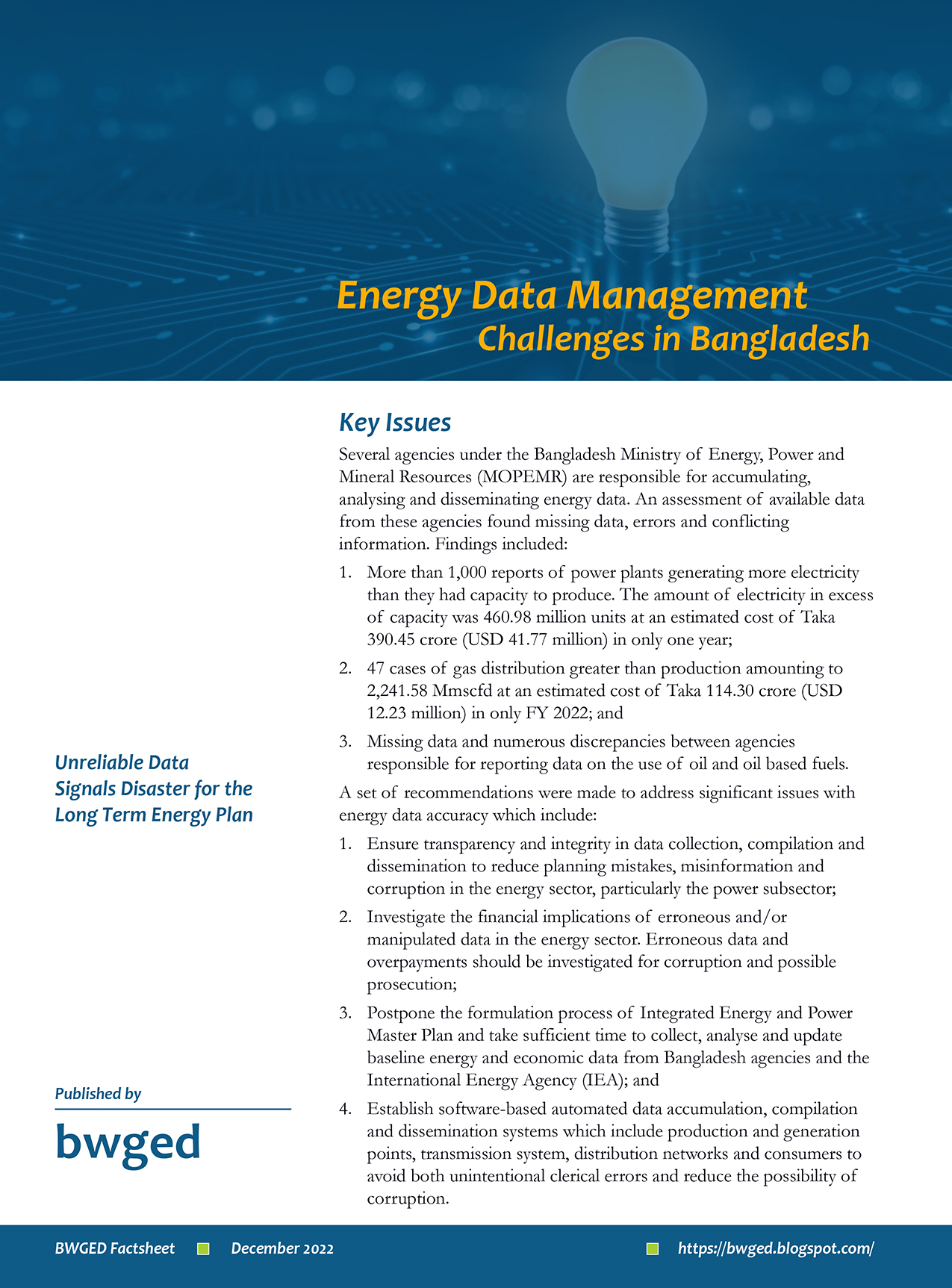
See the full report here

Energy Data Management: Challenges in Bangladesh

12 December 2022

Download the full report here
Find the Press Release here


Accurate data is critically important for instant decision-making, trend projections, and future planning in the energy sector. It is a key element that forecasts capital expenditures, balances demand and supply management, and assesses generation capacity. It also assists with the analysis of transmission & distribution, and pollution control measures and provides the factual basis for effective communication. Historical data on solar irradiation, wind speed, and velocity of water flow is obligatory to assess and predict the potential of renewable energy also. This baseline data is also the key prerequisite for designing upstream, midstream, and downstream services to meet current demands and project future requirements.

Several agencies under the Bangladesh Ministry of Energy, Power and Mineral Resources (MOPEMR) are responsible for accumulating, analyzing, and disseminating energy data. An assessment of available data from these agencies found missing data, errors, and conflicting information. MOPEMR is the key governing agency of the energy sector in Bangladesh. The Energy and Mineral Resource Division (EMRD) is responsible for supplying primary energy data such as coal, fossil gas, and petroleum while the Power Division is responsible for secondary energy such as electricity. Petrobangla deals with the production, transmission, and distribution of domestic energy resources, particularly coal and gas through its subsidiary companies.

There are 1,013 cases found where more electricity is being generated than the capacity to generate the power. In the most extreme cases, the power generation to power capacity mismatch was more than 200%. BPDB (2020-21) stated that 80,423 gWh (million units) of electricity was generated, while grid-connected power plants generated 80,294.75 million units. However, BPDB never mentioned the source of the additional 128.25 million units of electricity.

BPDB Monthly Progress Report of July 2022 showed the total generation capacity of grid-connected power plants was 22,482 MW, while the Daily Generation Report on 30 June 2022 shows the total capacity was 21,396 MW. This is 1,086 MW less than the amount mentioned in the Progress Report. Meanwhile, the Power Division reports that the total installed capacity of the country is 25,700 MW including off-grid and captive power plants. Meaning there are major inconsistencies in data within the entities.

The published renewable energy data highlights several inconsistencies in the amount of actual installed power production capacity. If the installed capacity of off-grid renewable energy is 359.24 MW as the Sustainable and Renewable Energy Development Authority (SREDA) reported, plus another 3,184 MW from captive power plants as reported by ADB Institute and 249.15 MW (BPDB reported as 253 MW) according to BREB Annual Report, the total installed capacity could be 25,188.39 MW to 26,278.24 MW respectively. The inconsistencies in the amount of actual installed power production capacity reported by these agencies indicate that there is no reliable, verified capacity baseline.

Fossil gas contributes to 61% of the primary energy mix in Bangladesh. Hence, the accuracy of data on fossil gas is much more important than any other sub-sectors of energy. Petrobangla is mandated to collect, compile, analyze and publish respective information on the production, import, and distribution of petroleum and mineral resources including Domestic Fossil Gas (DFG) and Liquefied Natural Gas (LNG). However, no data on petroleum is available on the website of Petrobangla. In reality, none of the agencies provide real-time data on coal, Heavy Fuel Oil (HFO), and High-Speed Diesel (HSD).

Petrobangla listed 71 DFG-based power plants with an installed capacity of 12,734 MW. However, this list excludes power plants such as Ashulia 11 MW Power Plant, Chandina 11 MW DFG Power Plant, etc. although, according to the Daily Generation Report of BPDB and PGCB, these power plants are generating electricity regularly.

Ensuring transparency, and integrity in energy sector data collection, compilation, and dissemination, investing in financial implications of erroneous or manipulated data, including the private sector in updating reports is critically important. We further recommend establishing automated software-based data management systems, delaying the formulation of the Integrated Energy and Power Master Plan to ensure effectiveness based on updated energy and economics data.

Download the full report here
Find the Press Release here

Challenges in Energy Data Management in Bangladesh: Media Release

12 December 2022
-----------------------------

Energy Data Mismanagement may increase the Current Electricity Crisis in Bangladesh: Unreliable and inconsistent data signals disaster for the long-term energy plans
Challenges in Energy Data Management in Bangladesh: Unreliable and inconsistent data signals disaster for the long-term energy plans


[12 December 2022, Dhaka] The recently published report on “Energy Data Management Challenges in Bangladesh'' by the Bangladesh Working Group on External Debt (BWGED) highlights the several agencies under the Ministry of Energy, Power and Mineral Resources (MOPEMR) responsible for disseminating misleading energy data. The report assesses available energy data from these agencies to find missing, erroneous, and inconsistent datasets. This conflicting data from different agencies under the same Ministry is misleading information for planners to use reliably to make future energy plans.

MOPEMR is the key governing agency of the energy sector in Bangladesh. The Energy and Mineral Resource Division (EMRD) is responsible for supplying primary energy data such as coal, fossil gas, and petroleum while the Power Division is responsible for secondary energy such as electricity. Petrobangla deals with the production, transmission, and distribution of domestic energy resources, particularly coal and gas through its subsidiary companies.

The report also emphasized that the recent electricity blackouts and grid failures are one of the signs that the foundation of accurate baseline energy information has been off for a long time in Bangladesh. Moreover, there are also severe concerns about credible governments or other entities reviewing and auditing the data for accuracy, transparency, and integrity along with erroneous data management.

The report found 1,013 cases of more electricity being generated than the capacity to generate the power. In the most extreme cases, the power generation to power capacity mismatch was more than 200%. BPDB (2020-21) stated that 80,423 gWh (million units) of electricity was generated, while grid-connected power plants generated 80,294.75 million units. However, BPDB never mentioned the source of the additional 128.25 million units of electricity.

The report shows, government entities often underreport the generation capacity of power plants compared to their actual capacities. The report highlights that the BPDB Monthly Progress Report of July 2022 showed the total generation capacity of grid-connected power plants was 22,482 MW, while the Daily Generation Report on 30 June 2022 shows the total capacity was 21,396 MW. This is 1,086 MW less than the amount mentioned in the Progress Report. Meanwhile, the Power Division reports that the total installed capacity of the country is 25,700 MW including off-grid and captive power plants. Meaning there are major inconsistencies in data within the entities.

The report further analyzes the published renewable energy data to highlight several inconsistencies in the amount of actual installed power production capacity. If the installed capacity of off-grid renewable energy is 359.24 MW as the Sustainable and Renewable Energy Development Authority (SREDA) reported, plus another 3,184 MW from captive power plants as reported by ADB Institute and 249.15 MW (BPDB reported as 253 MW) according to BREB Annual Report, the total installed capacity could be 25,188.39 MW to 26,278.24 MW respectively. The inconsistencies in the amount of actual installed power production capacity reported by these agencies indicate that there is no reliable, verified capacity baseline.

Moreover, the data management system has no mechanisms to calculate the generation from captive, commercial, and off-grid solar and hydroelectric power plants and hence is excluded from the national power generation records. This means that the power system utilization could be much lower than 40%, causing economic harm.

The report highlights that fossil gas contributes to 61% in the primary energy mix in Bangladesh. Hence, the accuracy of data on fossil gas is much more important than any other sub-sectors of energy. Petrobangla is mandated to collect, compile, analyze and publish respective information on the production, import, and distribution of petroleum and mineral resources including Domestic Fossil Gas (DFG) and Liquefied Natural Gas (LNG). However, no data on petroleum is available on the website of Petrobangla. In reality, none of the agencies provide real-time data on coal, Heavy Fuel Oil (HFO), and High-Speed Diesel (HSD).

Moreover, the report notes that Petrobangla listed 71 DFG-based power plants with an installed capacity of 12,734 MW. However, this list excludes power plants such as Ashulia 11 MW Power Plant, Chandina 11 MW DFG Power Plant, etc. although, according to the Daily Generation Report of BPDB and PGCB, these power plants are generating electricity regularly. Moreover, the list is not updated as retired power plants are not deleted from the database which makes it an even more unreliable source for future forecasting, preventing planners from making effective energy plans based on credible data.

The report recommends ensuring transparency, and integrity in energy sector data collection, compilation, and dissemination, investing in financial implications of erroneous or manipulated data, including the private sector in updating reports. The report further recommends establishing automated software-based data management systems, delaying the formulation of the Integrated Energy and Power Master Plan to ensure effectiveness based on updated energy and economics data.

The report is available in the link.

LNG Power Plants in Bangladesh


The Government of Bangladesh (GOB) planned to install 18 LNG based power plants with a capacity of 10,530 MW by 2030 in which 2,685 MW are at under construction stage now, 2,760 MW is approved and currently at pre-construction stage, 1475 MW is at pre-approval or proposed stage and 2410 MW is at the planning stage while 1200 MW has been shelved by the sponsor. 

Under Construction

  1. Meghnaghat 583 MW (Summit) LNG Power Plant. Gross Capacity: 589.75 MW. Sponsored by Summit Meghnaghat II Power Limited (SMIIPL), a JVC of Summit Group (53.9%), General Electric: (30%) and JERA (16.1%). Situated at Meghnaghat Island in Narayanganj District. EPC Contractor: General Electric (GE). Expected COD: March 2023
  2. Meghnaghat 584 MW (Unique) LNG Power Plant. Gross Capacity: 600 MW. Sponsored by Unique Meghnaghat Power Limited (UMPL), a JVC of Unique Group (50.1%), General Electric: (20%), Nebras Power (24%) and Strategic Finance & Investments Limited (5.9%). Situated at Dudhghata under Sonargaon Upazila in Narayanganj District. EPC Contractor: General Electric (GE). Expected COD: July 2023
  3. Meghnaghat 718 MW (Reliance) LNG Power Plant. Gross Capacity: 750 MW. Sponsored by Reliance Bangladesh LNG & Power Limited (RBLP), a JVC of Reliance Power Limited (51%) and JERA (49%). Situated at Meghnaghat Island in Narayanganj District: EPC Contractor: Samsung C&T. Expected COD: March 2023
  4. Rupsha 800 MW (NWPGCL) LNG Power Plant. Gross Capacity: 880 MW. Sponsored by North-West Power Generation Company Limited (NWPGCL), an SOE under BPDB. EPC Contractor: Shanghai Electric (China) & Ansaldo Energia (Italy). Expected COD: October 2023 (1st Unit) and April 2024 (2nd Unit) 

Pre-construction Stage

  1. Anwara 590 MW (United) LNG Power Plant. Gross Capacity: 600 MW. Sponsored by United Chattogram Power Limited, a JVC of United Group (60%), Kyushu Electric Power Company (20%) and Sojitz Corporation (20%). Expected COD: January 2026
  2. Gazaria 660 MW (EPH-WPL) LNG Power Plant. Gross Capacity: 660 MW. Sponsored by: EPH-WPL Consortium Limited, a JVC of Edra Power Holdings Sendirian Berhad (80%) and Winnievision Power Limited (20%). Expected COD: January 2026
  3. Meghnaghat 450 MW (Anlima) LNG Power Plant. Gross Capacity: 500 MW. Sponsored by Anlima Meghnaghat Power Limited, a JVC of Anlima Group (75%) and General Electric (25%). Expected COD: January 2026
  4. Mirsarai 660 MW (Confidence) LNG Power Plant. Gross Capacity: 660 MW. Sponsored by Confidence Chittagong Power Limited, a JVC of Consortium of Confidence Power Holdings Limited (62%), General Electric (20%), Confidence Power Limited (9%) and Electrapack Industries Limited (9%). Expected COD: June 2027
  5. Raozan 400 MW (BPDB) LNG Power Plant. Gross Capacity: 410 MW. Sponsored by Bangladesh Power Development Board (BPDB). EPC Conractor: SEPCOIII Electric Power Construction Company Limited. Expected COD: December 2025

Pre-approval Stage

  1. Haripur 250 MW (BPDB) LNG Power Plant. Gross Capacity: 250 MW. Proposed by Bangladesh Power Development Board (BPDB). Expected COD: June 2026
  2. Ghorashal 225 MW (BPDB) LNG Power Plant. Gross Capacity: 250 MW. Proposed by Bangladesh Power Development Board (BPDB). Expected COD: June 2027
  3. Mymensingh 400 MW (BRPL) LNG Power Plant. Gross Capacity: 420 MW. Proposed by B-R PowerGen Limited, a JVC of BPDB (50%) and Rural Power Company Limited (50%). Expected COD: June 2027
  4. Matarbari 600 MW (CPGCBL-Mitsui) LNG Power Plant. Gross Capacity: 660 MW. Jointly proposed by Coal Power Generation Company Bangladesh Limited (CPGCBL), an SOE under BPDB, and Mitsui & Company, Japan. Expected COD: June 2028

Planning Stage

  1. Gazaria 600 MW (RPCL) LNG Power Plant. Gross Capacity: 660 MW. Proposed by Rural Power Company Limited, an SOE under Bangladesh Rural Electrification Board (BREB). Expected COD: June 2028
  2. Siddhirganj 600 MW (BPDB) LNG Power Plant. Gross Capacity: 660 MW. Proposed by Bangladesh Power Development Board (BPDB). Expected COD: June 2029
  3. Sonagazi 600 MW (EGCBL) LNG Power Plant. Gross Capacity: 660 MW. Proposed by Electricity Generation Company of Bangladesh Limited (EGCBL), an SOE under BPDB. Expected COD: December 2029
  4. Bheramara 610 MW LNG Power Plant. Gross Capacity: 660 MW. Proposed by Bangladesh Power Development Board (BPDB). Expected COD: December 2030

Shelved

  1. Payra 1200 MW (NWPGCL) LNG Power Plant. Gross Capacity: 1200 MW. Proposed by North-West Power Generation Company Limited (NWPGCL), a SOE under BPDB, and Siemens AG, Germany. Expected COD: June 2026

Adani godda power plant: BPDB to pay Tk 1,219.1cr for power not used

8 June 2022 | Asifur Rahman | The Daily Star 
--------------------------------------------------------- 

If it does not add value, it is a waste, said the seminal American industrialist Henry Ford. And the quote best describes the situation the Bangladesh Power Development Board finds itself in with its deal with India's Adani Power. 


Engineered during Indian Prime Minister Narendra Modi's maiden visit to Bangladesh in 2015, Adani Power has set up a 1,600MW thermal power in Jharkhand's Godda to supply most of the power generated to BPDB through a dedicated transmission line. 

That power plant will be going into generation from August but its transmission would not be ready until December at least, meaning the power would be going to waste. 

And yet, BPDB would have to pay $141.1 million, or Tk 1,219.1 crore, in capacity charge for the four months to December, according to the report "Adani Godda Coal Power Plant: An Achilles Heel of the Power Sector of Bangladesh". 

Capacity charge is a penalty paid to the plant owner for failure to buy a certain portion of power readily available. 

As per the agreement signed in 2017, Adani Power would supply 1,496 MW of electricity for 25 years from December 2021. 

Because of the pandemic, the Adani Group subsidiary pushed the start date by six months. The power plant is all set to start commercial operation in August. 

But the Power Grid Company of Bangladesh (PGCB) said more time is needed to get the infrastructure ready to import electricity. It will take at least December this year. 

As per the agreement, Adani Power would install a dedicated 106 kilometres long 400 kV transmission line from Godda to the interconnection point. 

To relay the power from the point, PGCB took up a Tk 225.2 crore project to construct a 28 km transmission line from the Indo-Bangla border to the Rohanpur substation in Bangladesh. 

The substation is yet to be built as the materials have not arrived, Md. Mizanur Rahman Sarkar, project director of the transmission line, told The Daily Star. 

"We will be able to import power from about 800 MW in the early months of the next year," he said. 

BPDB has agreed to pay the Adani Godda power plant Tk 3.26 as the capacity charge per unit. For similar plants in Bangladesh, the capacity charge is Tk 2.83. 

Nasrul Hamid, the state minister for power, energy and mineral resources, is not sure yet whether BPDB would have to pay the capacity charge for the four months that power is not imported from Adani Power, which is founded by Gautam Adani, the world's fifth richest person. 

"But had we built it by ourselves and did not use the power, we would still have to make the capacity payment." 

The government policy of 'no electricity, no payment' is not applicable for such large-scale independent power producers, he told The Daily Star. 

"If we apply it, no one will agree to build a plant. Adani will invest and we have to pay a minimum return to them. If we don't take electricity, they will be in trouble," Hamid added. 

To offtake electricity from the Godda coal power plant, BPDB would be doing away with its usual 'merit order dispatch' method and go with the 'priority-based dispatch'. 

Under the 'merit order dispatch' method, the power plants supplying cheaper electricity are given the first opportunity to generate. 

But under the 'priority-based dispatch' method, the imported power will be transmitted first keeping the domestic power plants idle even if those generate electricity at a cheaper rate. 

So the power from Adani Godda will be 56.2 percent more expensive than other imported power, 36.9 percent more than imported coal power and 4.3 percent more than domestic coal power, according to the study by the Bangladesh Working Group on the External Debt and India-based Growthwatch. 

Bangladesh will have to pay more than Tk 1 lakh crore to the Adani coal power plant as a capacity charge over the 25-year lifetime of the agreement, which is equal to enough to build three Padma bridges, said the study published on Monday. 

In the worst-case scenario, BPDB will have to pay $423.3 million (Tk 3,657.2 crore), in capacity charges annually, and $11.01 billion (Tk 108,360.6 crore) over the plant's 25 years operational lifetime. 

The Padma bridge was built for $3.87 billion, the Dhaka metro rail for $2.59 billion and the Karnaphuli river tunnel for $1.22 billion, the report added. 

In the best-case scenario, the annual capacity charges payable to the Adani Godda power plant would be $331.66 million (Tk 2,865.55 crore), while the lifetime capacity charges would reach $8.62 billion (Tk 84,903.7 crore). 

Adani Power will have its investment returned in a maximum of six years and a minimum of 4.67 years, according to the report. 

"Capacity charge will depend on the availability of the power plant. If the power plant runs with 85 percent plant load factor (PLF), it will be the highest scenario and the power plant may drop its PLF at 53 percent, which is the lowest average in India," said Hasan Mehedi, one of the authors of the report. 

Upcoming Adani plant in Jharkhand to sell power to Bangladesh, will make its economy suffer: Report

7 June 2022 | Zumbish | DownToEarth
------------------------------------------------- 

The report also alleged the Adani Group forcibly acquired the land to build the plant from local farmers, without payment of proper compensation 

Photo: Twitter Handle of Gautam Adani

The Adani Godda ultra-supercritical coal power plant being built in Jharkhand’s Godda district by the Adani Group will sell its power to Bangladesh. But a new Indo-Bangladesh report accessed by Down To Earth has claimed that Bangladesh’s economy will suffer in the process, even as Adani will get richer. 

The report also alleged the Adani Group forcibly acquired the land to build the plant from local farmers, without payment of proper compensation. 

The report was published June 7, 2022 by the Bangladesh Working Group on External Debt (BWGED) — a forum of activists and India-based Growthwatch, a voluntary research and advocacy institution that protects natural resources from being grabbed by powerful groups. 

The report stated that Bangladesh Power Development Board (BPDB) signed an agreement with the Adani Group in November 2017 to offtake 1,496 megawatt power from Godda Coal Power Plant under a cross-border electricity trade arrangement. 

The BPDB agreed to pay 3.26 Bangladeshi taka (Rs 2.72) per kilowatt hour as capacity charge, which is higher than any other power plant in Bangladesh. 

“The Power Development Board will have to pay Tk 3,657.23 crore (approximately Rs 3,053.79 crore) in capacity charges annually and Tk 108,360.60 crore (Rs 90,470.265 crore) over the plant’s 25 years operational lifetime”. 

This, the report states, will thus make more money for Adani without benefitting Bangladesh citizens. 

The capacity charge is more than enough to build three bridges over the Padma river in Bangladesh or nine Karnaphuli river tunnels or four metro railways in Dhaka, the report stated. 

According to the report, the Padma Bridge was built at a cost of Rs 3,00,84,56,73,000 while the construction of metro railways in Dhaka cost Rs 2,01,34,11,61,000 and the Karnaphuli River tunnel cost Rs 94,83,15,15,000. 

Moreover, according to the report, in the best scenario, the annual capacity charges payable to the Adani Godda power plant would stand at Tk 2,865.55 crore (Rs 2,392.16 crore), while the lifetime capacity charges would reach Tk 84,903.72 crore (Rs 70,877.62 crore). 

“Since Bangladesh doesn’t need any more power, the amount spent will only benefit the Adani Group, not the people of Bangladesh,” Hasan Mehedi, member secretary of BWGED and one of the authors of the report, was quoted as saying. 

“So, the people and the Bangladesh economy particularly, will have to suffer for the luxury of a billionaire company who is getting richer every year,” Mehedi added. 

The coal-fired Adani Godda plant being built in Jharkhand may be commissioned in August. However, the transmission line required by Bangladesh in order to import power from the Indo-Bangla border is likely to not be ready by December. 

“BPDB will have to pay Tk 1,219.10 crore (Rs 1,017.70 crore) in capacity charges for the waiting period of four months even though no power will make its way to Bangladesh,” the report said. 

The report noted that the power plant may emit 221.1 million tonnes (MT) of carbon dioxide in its lifetime, with an average emission of 9.35 MT annually. 

“India is the third-largest country in the world which is committed to achieve net zero by 2070, instead of 2050. The position is highly criticised by the global community. This power plant will only help to establish India as a climate denier,” it said. 

The environmental and social cost of the emissions of hazardous air pollutants and carbon dioxide will be Rs 5,569.34 crore per year and Rs 188,708.29 crore over the plant’s lifetime. 

The report went on to recommend that in the light of the statements made during the 26th Conference of Parties to the United Nations Framework Convention on Climate Change in Glasgow, both Delhi and Dhaka should explore ways of annulling the existing bilateral agreement and replacing an agreement in line with the 2015 Paris Agreement and 2021 Glasgow commitments. 

“Both of the governments should cancel the Power Purchase Agreement and create a flexible supply regime for Renewable Energy (RE). Since it involves commercial agreements, a joint committee can be formed to resolve any issues arising out of the change,” it said. 

Kazi Maruful Islam, convener of BWGED and professor of the development studies department in the University of Dhaka, was quoted as saying, “Considering the energy security, Russia-Ukraine war and global economic crisis, there is no other way than cancelling these types of agreements and building a renewable energy based electricity system in Bangladesh.” 

Bangladesh will pay enough to build 3 Padma bridges as capacity payment to Adani

7 June 2022 | Eyamin Sajid | The Business Standard 
------------------------------------------------------------------ 

Three Padma Bridges, nine Karnaphuli River Tunnels or four metro rails: that is how many mega infrastructures Bangladesh can build with the money it is paying to the Indian Adani Group as capacity payment under a power purchase agreement (PPA). 


Bangladesh will pay around $11.01 billion for importing 1,496 megawatts (MW) of electricity from Adani Godda 1,600 MW Thermal Power Plant over its 25 years of lifetime revealed a report co-published by the Bangladesh Working Group on External Debt (BWGED) and Indian Growthwatch. 

"The amount for the capacity charge is nine times higher than the budget of Karnaphuli River Tunnel and more than four times than the Dhaka Metro Rail," said Hasan Mehedi, an author of the report and member secretary of the BWGED. 

Since 2010-2011, Bangladesh Power Development Board (BPDB) has paid around $8.54 billion as capacity charges to independent power producers (IIPs) and rental and quick rental power plants owners. 

"This power plant will be a huge burden on the Bangladesh economy. It doesn't make any sense to import coal power from India when Bangladesh is experiencing around 60% overcapacity now," Mehedi said. 

On 2 June, at a citizen discussion held at the National Press Club, State Minister of Power Energy and Mineral Resources Nasrul Hamid, however, claimed that the country does not have overcapacity in electricity. 

He said apart from captive power, the total installed capacity of power is around 21,000MW. But the capacity stands at 16,000 MW to 17,000MW if 10% for derated capacity and 10% for scheduled maintenance is excluded, whereas the current demand is around 14000MW. 

Instead, we see capacity shortage if we consider 20% standby reserve margin. 

The BPDB signed an agreement with Adani Group in November 2017 to offtake 1,496 MW power from its Godda Coal Power Plant under the cross-border electricity trade arrangement. 

As per the agreement, the BPDB agreed to pay $0.038 or Tk3.26 per (kilowatt hour) kWh as capacity charge, higher than any other power plant in Bangladesh. 

As per the report estimates, the cost of electricity from the Godda power plant will be at least tk9.09 per kWh, which is 56% higher than other imported electricity and 196% higher than solar power in India. 

According to the BWGED and Growthwatch's report, the Adani Group may take $423.29 million as capacity charge per year, but the money will not benefit the Bangladeshi people. 

In addition to that, the cost of electricity from the Godda Adani Group will increase by 5.5% per year, while the cost of solar power will be decreasing at a yearly rate of 10%. 

At present, Bangladesh imports 1,160MW electricity from India through cross-border electricity trade agreements. 

The first unit of 1600 MW is scheduled to start commercial operation by this July while the second unit will come online by December this year. 

But the corresponding transmission line from Indo-Bangla border to Bangladeshi national grid has not been prepared yet. 

Sources at the BPDB said that Bangladesh won't be able to receive the electricity until December this year. 

Even if the transmission line were built by December 2022 according to the plan, Bangladesh will have to pay $141.10 million of capacity charges in four months only. 

Md Mizanur Rahman Sarkar, project director at Rahanpur to Monakasha Border 400kV Transmission Line, told The Business Standard, "The physical work of the Bangladesh part of the project is almost completed. But transmission line in the Indian side has yet not been completed." 

Sarkar, however, said that the power evacuation would be started within five to six months. 

For evacuating electricity from the plant, 134 km (30km in Bangladesh side and 104km in Indian side) transmission line construction project was taken by both countries.